
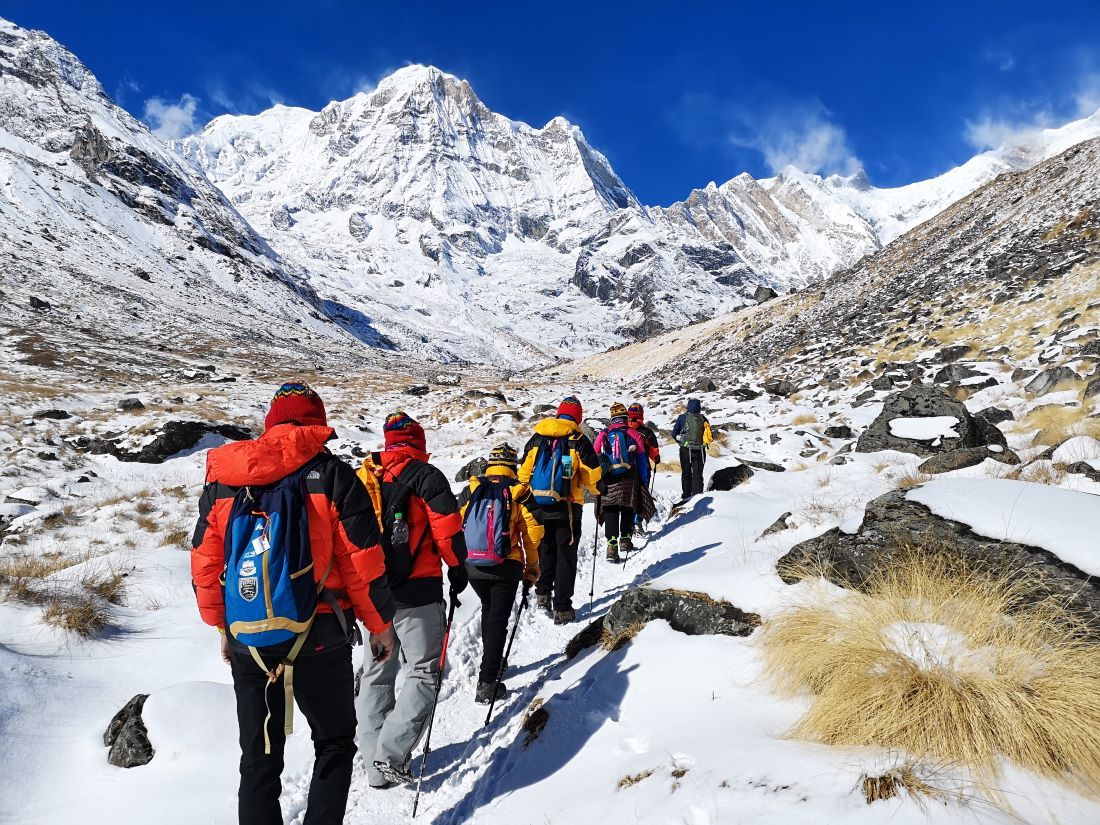
Discover the Annapurna Base Camp Trek in 2027
The Annapurna Base Camp Trek takes you into a mountain sanctuary surrounded by some of the highest peaks in the Annapurna range. The route follows the Modi Khola valley through traditional Gurung villages, stone staircases, bamboo forests, and high-altitude settlements before reaching Annapurna Base Camp at 4,130 metres.
The Annapurna Base Camp route enters into the heart of the Annapurna Sanctuary. The mountains become increasingly close as you walk beyond Chhomrong, and the valley gradually narrows towards Machhapuchhre Base Camp and Annapurna Base Camp.
It requires physical preparation, particularly for long uphill and downhill sections, but it does not involve technical climbing. After spending the night at base camp, you retrace the trail to Bamboo and return to Pokhara.
Annapurna Base Camp Trek 2027 – Trip Overview
Before booking, you need to understand the actual route, maximum elevation, walking days, and accommodation arrangements.
| Trip information | Details |
| Trek name | Annapurna Base Camp Trek |
| Duration | 10 days |
| Region | Annapurna, Nepal |
| Starting point | Kathmandu |
| Highest point | Annapurna Base Camp, 4,130 m |
| Difficulty | Moderate to challenging |
| Trekking style | Teahouse trekking |
| Approximate trekking distance | 55–65 km, depending on trailhead and route conditions |
| Daily walking time | Approximately 4–7 hours |
| Meals | Three meals daily during the trek |
| Best seasons | March–May and September–November |
| Group type | Private and small-group departures |
The exact walking distance depends on the roadhead used, trail diversions, and the condition of the route. The walking time also changes according to the group’s pace, weather, and the number of breaks.
What Makes the Annapurna Base Camp Trek Different?
The main distinction is that the route takes you directly into the Annapurna Sanctuary. Instead of viewing the mountains from distant ridges, you walk into a high glacial basin surrounded by steep mountain walls.
There are several reasons trekkers choose this route.
-
Walking Through Traditional Gurung Settlements
Chhomrong is one of the important settlements on this route. The village lies on a hillside above the Modi Khola valley and provides views towards Annapurna South and Machhapuchhre.
The stone-paved paths, traditional houses, agricultural terraces, and local teahouses offer a different experience from the higher mountain settlements.
You will also meet people whose livelihoods depend on farming, tourism, and the movement of supplies along the trekking route.
-
Changing Forests and Mountain Landscapes
The lower trail passes through forests containing oak, rhododendron, and bamboo. During spring, rhododendrons flower across sections of the route.
The forest gradually becomes thinner as you gain elevation. Near Deurali, steep cliffs and exposed mountain slopes replace much of the dense vegetation.
This change is one of the most noticeable parts of the journey.
-
A Sunrise at Annapurna Base Camp
Spending the night at Annapurna Base Camp gives you an opportunity to see the surrounding peaks in the early morning.
The first sunlight reaches the upper mountain faces, while the lower valley can remain in shadow. Annapurna I and the surrounding peaks gradually become brighter as the morning develops.
Weather determines how much of the mountain panorama you can see. Cloud, snowfall, and wind can change conditions quickly, so the sunrise should be treated as an opportunity rather than a guarantee.
-
A Manageable Trek Without Technical Climbing
The ABC route does not require mountaineering skills, ropes, or technical climbing equipment under normal trail conditions.
However, that does not mean it is an easy walk. Long staircases, uneven paths, steep descents, and altitude make the trek physically demanding. A reasonable level of fitness and a willingness to walk at a steady pace are important.

Annapurna Base Camp Trek 2027 – Complete 10-Day Itinerary
Day 1: Arrival in Kathmandu (1,400 m)
Your journey begins in Kathmandu, Nepal’s capital. After landing at Tribhuvan International Airport, complete immigration formalities, collect your luggage, and meet the Sali Trekking representative outside the arrival area.
You will then be transferred to your hotel. Depending on your arrival time, you can spend the remainder of the day resting or walking around the nearby streets.
If you have already brought your trekking equipment, use this day to check that everything is ready. Your guide can discuss the route, walking arrangements, and the weather expected during your departure period.
Your guide will explain the next day’s transport arrangements and confirm the departure time.
Day 2: Drive or Fly from Kathmandu to Pokhara (Approximately 822 m)
Accommodation: Hotel in Pokhara
Meals: Breakfast, if included in the hotel arrangement
Transportation: Tourist bus or domestic flight
After breakfast, you travel from Kathmandu to Pokhara, the main gateway to the Annapurna region. There are two common ways to make this journey.
By tourist bus: The road journey usually takes around 7–9 hours, depending on traffic, road conditions, and construction work. The route follows the Prithvi Highway, passing river valleys, hills, settlements, and agricultural areas.
By domestic flight: A flight takes approximately 25–30 minutes. It is a practical option for travellers who want to save time, although flights remain subject to weather and operating conditions.
After arriving in Pokhara, transfer to your hotel. The remainder of the day is available for exploring the Lakeside area.
Pokhara also provides the last convenient opportunity to purchase small items for the trek. You should withdraw sufficient cash because there are no reliable ATM facilities along the upper trekking route.
Guide’s tip: If you choose the road journey, carry water, snacks, and any medication you normally need during long drives. Road delays are possible, so avoid arranging important activities immediately after your expected arrival.
Day 3: Pokhara to Chhomrong (Approximately 2,170 m)
Accommodation: Teahouse in Chhomrong
Meals: Breakfast, lunch, and dinner
Transportation: Road transfer to Jhinu Danda
Walking time: Approximately 2–3 hours
Walking distance: Approximately 3–5 km, depending on the starting point
Today you leave Pokhara and travel towards Jhinu Danda, where the walking section of the trek begins.
The road journey follows the countryside north of Pokhara, passing settlements, agricultural land, and sections of the Modi Khola valley. Depending on road conditions and the vehicle used, the drive generally takes around three hours.
After reaching the roadhead near Jhinu Danda, you begin walking towards Chhomrong.
The trail involves an uphill climb through terraced land and forested slopes. Although the walking distance is relatively short, the climb can feel demanding after the drive, especially if you have spent the previous day travelling from Kathmandu.
Chhomrong is one of the largest settlements on the ABC route. It is built along a hillside and has several teahouses, shops, and places to eat. From the village, you can see Annapurna South and Machhapuchhre when the weather is clear. These peaks become increasingly prominent as you move further into the valley.
Once you arrive, check into your teahouse, have your meal, and prepare for the following day’s descent and climb.
Guide’s tip: Do not rush the first uphill section. Your body is beginning to adjust to walking at altitude, and there is no advantage in using all your energy on the first trekking day.
Day 4: Chhomrong to Bamboo (Approximately 2,310 m)
Accommodation: Teahouse in Bamboo
Meals: Breakfast, lunch, and dinner
Walking time: Approximately 5–6 hours
Walking distance: Approximately 8–9 km
The fourth day takes you deeper into the Modi Khola Valley.
You begin by descending the stone staircases from Chhomrong towards Chhomrong Khola. This is one of the more noticeable downhill sections of the route. After crossing the suspension bridge, the trail climbs towards Sinuwa.
The route contains many stone steps, so your knees and leg muscles will work hard even though you are not carrying a large backpack.
Beyond Sinuwa, the path enters forested terrain. Bamboo, oak, and rhododendron trees cover sections of the hillside, and the trail follows the valley towards Bamboo. You will pass small settlements and teahouses along the way. Bamboo is a small trekking settlement surrounded by dense vegetation. Accommodation is generally basic, with shared facilities in many teahouses.
Day 5: Bamboo to Deurali (Approximately 3,200 m)
Accommodation: Teahouse in Deurali
Meals: Breakfast, lunch, and dinner
Walking time: Approximately 5–6 hours
Walking distance: Approximately 9 km
Today the trail continues uphill through the upper Modi Khola valley.
After leaving Bamboo, you pass through forested sections towards Dovan. The route gradually gains elevation, and the vegetation changes as you approach higher ground.
You continue past the Himalaya, to another small settlement where trekkers commonly stop for refreshments. The trail follows the river through a narrow valley, passing waterfalls, rocky slopes, and sections where the surrounding cliffs become more prominent.
As you approach Deurali, the forest begins to thin. The landscape becomes more exposed, and the mountain environment starts to feel different from the lower villages.
Deurali is an important overnight stop before the final climb towards Machhapuchhre Base Camp and Annapurna Base Camp. At approximately 3,200 metres, you are now at an elevation where altitude-related symptoms can become more noticeable.
Your guide will check how you are feeling and monitor the group’s walking condition. If anyone develops symptoms of altitude sickness, the guide should assess the situation before the group continues higher.
Guide’s tip: If you develop a headache accompanied by nausea, dizziness, or unusual fatigue, tell your guide. Do not hide symptoms to keep the itinerary on schedule. Continuing to ascend while altitude sickness is worsening can become dangerous.
Day 6: Deurali to Annapurna Base Camp (4,130 m)
Accommodation: Teahouse at Annapurna Base Camp
Meals: Breakfast, lunch and dinner
Walking time: Approximately 5–6 hours
Walking distance: Approximately 7 km
This is the main destination day of your trek. Leave Deurali after breakfast and follow the trail towards Machhapuchhre Base Camp. The landscape is more open than the forested sections below, and the route passes through rocky ground with steep slopes rising on either side of the valley.
The trail follows the upper Modi Khola area, and the vegetation becomes increasingly limited as you gain altitude. After reaching Machhapuchhre Base Camp (approximately 3,700 m), take a break and assess the weather and your physical condition.
From here, the route continues towards Annapurna Base Camp. The trail gradually climbs through the high mountain basin, with views of surrounding peaks becoming more extensive. Eventually, you arrive at Annapurna Base Camp at approximately 4,130 metres.
The base camp is located within the Annapurna Sanctuary. Annapurna I (8,091 m), Annapurna South, Hiunchuli, Gangapurna and Machhapuchhre form the surrounding mountain panorama. Unlike viewpoints located far below the summits, the base camp places you directly within the mountain basin.
After checking into your accommodation, take time to rest. You can walk around the designated areas near the teahouses if conditions permit, but avoid unnecessary physical activity. The temperature can drop considerably after sunset. Keep your warm clothing, gloves and insulated jacket accessible.
Guide’s tip: The walk from Deurali to ABC is the highest section of the itinerary. Maintain a slow pace, take regular breaks and inform your guide immediately if you experience a persistent headache, nausea, dizziness, breathlessness at rest or difficulty walking normally.
Day 7: Sunrise at Annapurna Base Camp and Trek Back to Bamboo (Approximately 2,310 m)
Accommodation: Teahouse in Bamboo
Meals: Breakfast, lunch and dinner
Walking time: Approximately 6–7 hours
Walking distance: Approximately 15–16 km
Wake up early if the weather allows. The morning at Annapurna Base Camp is one of the main reasons for spending the night at this elevation. As the sunlight reaches the surrounding peaks, Annapurna I and the neighbouring mountains gradually become visible in changing light.
After breakfast, begin descending towards Bamboo. You retrace the route through Machhapuchhre Base Camp and Deurali, then continue past Himalaya and Dovan before reaching Bamboo.
Although most of the journey is downhill, it should not be treated as an easy day. The descent covers a considerable distance, and the trail includes rocky sections, uneven steps and narrow paths. Your legs may already be tired from the previous days of climbing.
Take regular breaks, especially on steep sections. Keep your trekking poles available and avoid rushing downhill. By the time you reach Bamboo, you will have completed the return from the highest point of the trek and descended nearly 1,800 metres. Spend the evening resting at the teahouse.
Guide’s tip: Start early enough to complete the descent in daylight. Do not spend too long at the upper viewpoints if weather conditions are deteriorating or the group is moving slowly.
Day 8: Bamboo to Jhinu Danda and Drive to Pokhara (Approximately 822 m)
Accommodation: Hotel in Pokhara
Meals: Breakfast and lunch; dinner according to the package arrangement
Walking time: Approximately 5–6 hours
Walking distance: Approximately 11–12 km
Transportation: Jeep or vehicle to Pokhara
Today you leave Bamboo and return towards the roadhead.
The trail passes through Dovan and Sinuwa before reaching the Chhomrong area. You will retrace sections of the route climbed earlier in the trek. One important feature of this day is the combination of uphill and downhill walking. Although you are descending overall, the return route includes another climb towards Chhomrong before continuing down to Jhinu Danda.
After reaching the roadhead near Jhinu Danda, meet your vehicle for the drive back to Pokhara.
If time, energy and local conditions allow, you may be able to visit the Jhinu Danda hot springs. They are located below the village, and reaching them requires an additional walk down towards the river.
The hot springs are optional and should not interfere with the vehicle departure or the group’s travel schedule. After reaching Pokhara, check into your hotel. A hot shower, a proper bed and a meal in the Lakeside area will feel different after several nights in mountain teahouses.
Guide’s tip: Keep a change of clothes in your main luggage or vehicle. You will appreciate having clean clothes available after completing the mountain section.
Day 9: Pokhara to Kathmandu (Approximately 1,400 m)
Accommodation: Hotel in Kathmandu
Meals: Breakfast, depending on your hotel arrangement
Transportation: Tourist bus or domestic flight
After breakfast, return to Kathmandu. You can travel by tourist bus or domestic flight, depending on your preference and booking arrangements. The road journey normally takes around 7–9 hours, although traffic and road conditions can extend the travel time.
A flight takes approximately 25–30 minutes, making it a suitable option if you want to spend more time in Kathmandu or have an international departure approaching.
After arriving in Kathmandu, transfer to your hotel. The remaining time can be used for shopping, visiting cultural sites or enjoying a final evening in the city. You may also use this day to purchase souvenirs, visit Thamel or have a meal at one of Kathmandu’s restaurants.
Guide’s tip: If you have an international flight the following day, avoid making additional long-distance travel plans. Keep enough time for airport transfers and check-in.
Day 10: Departure or Extend Your Stay
Meals: Breakfast, depending on your hotel arrangement
Activity: Airport transfer or additional travel
Your Annapurna Base Camp Trek concludes today. A Sali Trekking representative will arrange your airport transfer according to your flight schedule if this service is included in your booking. If you have additional time in Nepal, you can extend your stay rather than leaving immediately. Some options include:
- Kathmandu Valley: Visit Kathmandu Durbar Square, Patan Durbar Square, Bhaktapur Durbar Square and Swayambhunath.
- Chitwan: Spend a few days exploring the Terai region, including wildlife activities in Chitwan National Park.
- Pokhara: Stay longer for boating, paragliding, short hikes and sightseeing.
- Poon Hill: Add a short trekking extension for another mountain viewpoint.
- Mardi Himal: Consider a separate trekking journey through the eastern Annapurna region.
Your guide or Sali Trekking office can help arrange additional services according to your schedule.
Annapurna Base Camp Trek Route and Elevation
The route begins at the lower hills near Jhinu Danda, climbs through Chhomrong and Bamboo, passes Deurali and Machhapuchhre Base Camp, and reaches Annapurna Base Camp at 4,130 metres. The elevation changes are important because they determine the physical effort required and the amount of time your body has to adjust.
| Location | Approximate elevation |
| Kathmandu | 1,400 m |
| Pokhara | 822 m |
| Chhomrong | 2,170 m |
| Bamboo | 2,310 m |
| Dovan | 2,600 m |
| Himalaya | 2,920 m |
| Deurali | 3,200 m |
| Machhapuchhre Base Camp | 3,700 m |
| Annapurna Base Camp | 4,130 M |
These elevations are approximate. Small differences may appear between maps, teahouse locations and GPS readings.
Understanding the Elevation Gain
The most noticeable elevation gain begins after leaving Chhomrong. The trail climbs through Sinuwa and Bamboo before continuing towards Deurali. The next day, you move above 3,000 metres and approach Machhapuchhre Base Camp. The final ascent to Annapurna Base Camp brings you to 4,130 metres.
The return journey is physically demanding for a different reason. You lose elevation over long distances, and the repeated downhill steps place considerable pressure on the knees and quadriceps. This is why trekking poles and appropriate footwear are useful throughout the route.
How Much Does the Annapurna Base Camp Trek Cost in 2027?
A guided 10-day Annapurna Base Camp Trek package can cost approximately USD 700–1,100 per person in the current market, depending on group size, transport, accommodation, meals, porter arrangements and included services. The proposed Sali Trekking starting price for this draft is USD 799 per person, subject to confirmation.
The advertised price should be compared against the actual services included in the package. A lower price does not necessarily mean better value if essential transport, meals, permits or staff services are charged separately.
| Group size | Proposed price per person |
| 1 person | On Request |
| 2-3 people | From USD 799 |
| 4-7 people | Group quotation |
| 8-12 people | Special group quotation |
What Is Included in the Trek Package?
The current Sali Trekking ABC package listing describes the following services:
- Airport pickup and drop-off.
- City accommodation according to the package arrangement.
- Mountain teahouse accommodation.
- English-speaking trekking guide.
- Porter service.
- Three main meals daily during the trekking period, with tea or coffee as specified.
- Annapurna trekking permits.
- Sleeping bag and duffel bag.
- Ground transportation.
- Comprehensive medical kit.
- Company T-shirt.
- Certificate of achievement and medal.
What Is Not Included?
The following expenses should be budgeted separately unless your written quotation specifically includes them:
- International airfare.
- Nepal tourist visa.
- Travel insurance and emergency helicopter evacuation.
- Lunch and dinner in Kathmandu and Pokhara.
- Personal snacks, chocolates and drinks.
- Bottled or boiled water.
- Hot showers.
- Battery charging and Wi-Fi.
- Personal trekking equipment.
- Guide and porter tips.
- Additional accommodation or meals resulting from delays.
- Expenses caused by unforeseen circumstances.
- Other personal purchases.
- Additional Money to Carry
Even if you have booked a full-board trekking package, carry some Nepalese rupees for personal expenses. You may need money for:
- Extra tea and coffee.
- Chocolate and snacks.
- Hot showers.
- Charging electronic devices.
- Wi-Fi.
- Additional drinks.
- Tips for trekking staff.
Withdraw sufficient cash in Kathmandu or Pokhara. Do not depend on ATMs being available after the trek begins.
Annapurna Base Camp Trek Permit Requirements for 2027
Foreign trekkers need the Annapurna Conservation Area Permit (ACAP) and must follow the applicable guide and TIMS requirements. Sali Trekking can arrange the required documentation as part of the organised trek. The Annapurna Base Camp route lies within the Annapurna Conservation Area, which is managed for conservation and sustainable tourism.
-
Annapurna Conservation Area Permit (ACAP)
The ACAP permit allows you to enter the protected area. The permit system supports conservation work and the management of tourism activities within the Annapurna region. For foreign visitors, the commonly published entry fee is NPR 3,000. SAARC and Nepali citizen rates differ.
-
TIMS Card
The Trekkers’ Information Management System records trekking information and supports the management of trekking activities. The current agency-issued TIMS fee commonly listed for foreign visitors outside SAARC is NPR 2,000, with a different rate for SAARC nationals. Permit fees and procedures should be checked again before your 2027 departure because government regulations can change.
-
Licensed Trekking Guide
Foreign trekkers on designated trekking routes in Nepal are subject to the licensed-guide requirement introduced by the Nepal Tourism Board in 2023. For an organised ABC trek, Sali Trekking arranges a guide and assists with the required permit process. You should provide the company with the necessary passport information and photographs in advance.
Keep a copy of your passport and insurance information on your phone and in your daypack. Your guide should have the necessary permit documents available during the trek.
Best Time for Annapurna Base Camp Trek 2027
March to May and late September to November are generally the preferred periods. Spring offers rhododendron flowers, while autumn usually provides good visibility after the monsoon.
Spring (March to May)
Spring is one of the most popular periods for trekking to Annapurna Base Camp. The lower forests begin to show new growth, and rhododendrons flower across different elevations. March can still bring cold nights and occasional snow at higher elevations, while April and May are generally warmer.
During this season:
- Forest sections become colourful with rhododendron flowers.
- Daytime temperatures are generally more comfortable at lower elevations.
- Snow may remain around Deurali and the upper sanctuary.
- Afternoon cloud can reduce mountain visibility.
- Higher settlements can become busy during peak trekking weeks.
Spring is a good choice for trekkers who want to combine mountain scenery with the flowering forests of the Annapurna region.
Autumn (September to November)
Autumn is another preferred trekking season. The monsoon generally withdraws during September, although early September can still receive rainfall. October and November are usually the most popular months for clear mountain views.
During autumn:
- Mountain visibility is often good.
- Daytime walking conditions are generally comfortable.
- Nights become colder as November progresses.
- Accommodation can become busy during major trekking periods.
- The trail may be slippery immediately after rainfall.
October is particularly popular, so advance accommodation and transport arrangements are advisable.
Winter (December to February)
Winter trekking is possible, but cold conditions become more serious at higher elevations. Temperatures at Annapurna Base Camp can fall well below freezing, especially at night. Snowfall may affect the trail between Deurali and ABC. Trekkers considering winter should be prepared for:
- Very cold nights.
- Snow-covered paths.
- Reduced daylight.
- Possible temporary trail closures.
- Changes to accommodation availability.
- Additional risks from icy sections and avalanches.
The decision to continue towards base camp should depend on actual conditions, not simply the planned itinerary.
Monsoon (June to August)
The monsoon brings frequent rainfall to the Annapurna region. Lower sections can become muddy, slippery and affected by landslides. Leeches are also common in forested areas during wet periods. Mountain views may be limited by cloud and rain.
The trek can still be organised during the monsoon, but it requires more flexibility and careful attention to weather and trail reports.
How Difficult Is the Annapurna Base Camp Trek?
The ABC trek is generally moderate to challenging. It does not require technical climbing, but the long staircases, steep ascents, extended descents and elevation make it physically demanding. The difficulty depends on your fitness, walking experience, acclimatisation and the weather during your trek.
Uphill Sections
The climb from Chhomrong towards Sinuwa is one of the sections that many trekkers remember. The route contains long stone staircases, followed by forest paths and gradual climbs towards Bamboo. Above Bamboo, the trail continues gaining elevation towards Deurali. The final section towards Machhapuchhre Base Camp and ABC requires more careful pacing.
Downhill Sections
The return from ABC to Bamboo involves a substantial descent. Walking downhill for several hours can be harder on the knees than expected, especially after consecutive days of trekking. Trekking poles help with balance and reduce some of the load on your legs.
Altitude
Annapurna Base Camp stands at 4,130 metres. Although this is lower than some of Nepal’s other major trekking destinations, altitude sickness remains a genuine concern. Symptoms can begin above approximately 2,500 metres and become more noticeable as you ascend.
A slow walking pace, sufficient rest and early reporting of symptoms are important.
Who Can Complete This Trek?
The route is suitable for people with reasonable physical fitness who can walk for several hours on consecutive days. Previous trekking experience is helpful but not essential.
First-time trekkers should prepare properly and understand that the itinerary includes long days rather than short sightseeing walks. People with existing medical conditions should seek appropriate medical advice before booking.
Physical Preparation for Annapurna Base Camp Trek
Begin training at least six to eight weeks before departure. Focus on cardiovascular fitness, leg strength, stair climbing and walking on uneven ground. You do not need to train like a mountaineer, but you should prepare for repeated days of walking.
- Walking Practice
Start with regular walks and gradually increase the duration. Aim to become comfortable walking for two to three hours before progressing to longer sessions. Include hills, stairs and uneven paths whenever possible.
- Cardiovascular Training
Activities such as cycling, jogging, swimming and brisk walking can improve your endurance. Try to exercise three or four times a week. The objective is to maintain a steady effort for several hours, not to achieve maximum speed.
- Leg Strength
The route involves repeated climbing and descending. Useful exercises include:
- Squats.
- Step-ups.
- Lunges.
- Calf raises.
- Controlled step-downs.
These exercises help prepare your legs for the stone staircases around Chhomrong and the longer descent from ABC.
- Practice with Your Daypack
Walk with a light backpack containing water, a jacket and other essentials. This helps you understand how the pack sits on your shoulders and whether its straps need adjustment.
- Prepare Your Footwear
Wear your trekking boots or shoes during training. Do not start the trek with completely new footwear. Blisters can make even a moderate walking day uncomfortable.
Altitude Sickness on the Annapurna Base Camp Trek
Altitude sickness can occur on the ABC trek, particularly after passing 3,000 metres. Do not ignore headaches, nausea, dizziness or unusual fatigue.
Acute mountain sickness (AMS) is the most common form of altitude illness encountered by trekkers. It can affect people regardless of age, gender or fitness level. The common symptoms of AMS are:
- Headache.
- Nausea.
- Dizziness.
- Loss of appetite.
- Unusual tiredness.
- Difficulty sleeping.
Mild symptoms should be reported to your guide and monitored. If symptoms worsen, you should not continue ascending.
Serious Altitude Illness
High-altitude cerebral edema (HACE) and high-altitude pulmonary edema (HAPE) are serious medical emergencies. Warning signs include confusion, difficulty walking straight, breathlessness at rest, a persistent cough and unusual weakness. If these symptoms appear, immediate medical assessment and descent are required. Emergency evacuation may be necessary.
How to Reduce the Risk
- Walk slowly as you gain elevation.
- Drink sufficient fluids.
- Avoid alcohol during the trek.
- Do not continue ascending with worsening symptoms.
- Eat regular meals.
- Follow your guide’s advice.
- Allow additional time if your body is not adjusting well.
A guide should never pressure a trekker to continue upwards simply to maintain the original schedule.
Accommodation During the Annapurna Base Camp Trek
Kathmandu and Pokhara accommodation is in hotels, while the mountain section uses locally operated teahouses.The accommodation changes as you move from the cities into the Annapurna region.
Kathmandu and Pokhara
City hotels offer more facilities than mountain lodges. Depending on the package, you may have a private room, attached bathroom, hot shower, Wi-Fi and breakfast. The final hotel category should be confirmed before booking.
Chhomrong
Chhomrong has several teahouses and guesthouses. Rooms are generally simple, with twin beds and shared bathrooms in many establishments. Some lodges offer attached bathrooms, but availability depends on the property and season.
Bamboo
Bamboo is a smaller settlement surrounded by forest. Accommodation is basic, and facilities are more limited than in Chhomrong. Rooms are generally arranged around the main dining area.
Deurali
Deurali has a small number of teahouses. Facilities become more limited as the trail gains elevation. The temperature is lower, and hot water, charging and Wi-Fi may involve additional fees or may not be available.
Annapurna Base Camp
Accommodation at ABC is basic and designed around the needs of trekkers. Rooms are usually shared, and facilities are limited. At this altitude, warmth and adequate rest matter more than hotel-style comfort. Carry suitable cold-weather clothing and a sleeping bag.
Important: Accommodation availability at higher elevations can change according to weather and the number of trekkers. Private rooms and attached bathrooms should never be assumed unless confirmed.
Food During the Annapurna Base Camp Trek
Teahouses serve a mixture of Nepali meals and familiar international dishes. Dal bhat, noodles, rice, soups, potatoes, eggs and porridge are commonly available. Food is an important part of maintaining energy during the trek.
Dal Bhat
Dal bhat is one of the most practical meals on the route. It generally consists of rice, lentil soup, vegetables and additional side dishes. It provides carbohydrates and other nutrients that help support long walking days.
Noodles and Pasta
Noodles and pasta are common teahouse options. They are useful when you want a quick meal, although you should avoid relying only on processed foods throughout the trek.
Soups
Garlic soup, vegetable soup and other warm dishes are available at many teahouses. Hot meals can be particularly welcome during cold evenings at higher elevations.
Breakfast
Common breakfast choices include:
- Porridge.
- Eggs.
- Toast.
- Pancakes.
- Tibetan bread.
- Tea and coffee.
Drinking Water
Water is available at the teahouses, but you should treat water appropriately before drinking it. You can use purification tablets, a suitable filter or another approved treatment method. Avoid depending entirely on single-use plastic bottles. Carry a reusable bottle and refill it safely.
What Should You Pack for the Annapurna Base Camp Trek 2027?
Pack in layers, carry waterproof protection, bring suitable footwear and prepare for freezing temperatures at ABC. The lower villages and the base camp have very different temperatures. Your clothing should allow you to adjust as the elevation changes.
Clothing
- Moisture-wicking base layers.
- Fleece or insulating mid-layer.
- Warm down jacket.
- Waterproof jacket.
- Waterproof trousers or rain protection.
- Trekking trousers.
- Thermal leggings.
- Warm trekking socks.
- Gloves.
- Warm hat.
- Sun hat or cap.
- Comfortable clothes for the city.
Footwear
- Broken-in trekking boots.
- Comfortable camp shoes or sandals.
- Spare socks.
- Gaiters if snow conditions require them.
Essential Equipment
- 30–40 litre daypack.
- Sleeping bag suitable for temperatures around -10°C.
- Trekking poles.
- Headlamp.
- Sunglasses.
- Sunscreen.
- Reusable water bottles.
- Water purification system.
- Power bank.
- Personal first-aid supplies.
Personal Documents
- Passport.
- Nepal visa documents.
- Travel insurance.
- Trekking permits.
- Emergency contact details.
- Booking confirmation.
What Does Sali Trekking Provide?
The existing Sali Trekking package listing includes a sleeping bag and duffel bag.
Check the exact equipment specifications and availability before departure. You should still bring your own personal clothing, footwear, toiletries and essential medication.
Travel Insurance for Annapurna Base Camp Trek
Travel insurance should cover trekking at 4,130 metres and emergency helicopter evacuation. Not every standard travel insurance policy covers high-altitude trekking. Before purchasing a policy, check the following:
- The maximum trekking altitude covered.
- Emergency medical treatment.
- Helicopter evacuation.
- Hospitalisation.
- Medical repatriation.
- Trekking and hiking activity exclusions.
- The policy should cover the actual altitude and activities involved in your itinerary.
If a medical emergency occurs in a remote part of the Annapurna region, evacuation arrangements can be expensive. Carry your insurance details and emergency assistance telephone number.
Transportation for Annapurna Base Camp Trek
The itinerary uses road transportation between Kathmandu, Pokhara and the trekking trailhead. Domestic flights can replace the Kathmandu–Pokhara road journeys.
Kathmandu to Pokhara
The tourist bus journey takes approximately 7–9 hours, depending on road conditions. A domestic flight generally takes 25–30 minutes.
Pokhara to Jhinu Danda
The journey from Pokhara to the trailhead takes approximately three hours, depending on the road and vehicle. The route may involve rough road sections, particularly beyond the main highway.
Jhinu Danda to Pokhara
After completing the descent on Day 8, you return by road to Pokhara. The journey generally takes around three hours, although traffic and road conditions can change the travel time.
Pokhara to Kathmandu
You can return by tourist bus or flight. If you choose a flight, remember that weather-related delays are possible. Keep sufficient time between your domestic journey and international departure.
Is the Annapurna Base Camp Trek Suitable for Beginners?
Yes, beginners with reasonable fitness can complete the trek, provided they prepare properly and follow a sensible walking pace. You do not need previous mountaineering experience. The main challenges are:
- Walking for several consecutive days.
- Climbing and descending stone staircases.
- Adjusting to increasing elevation.
- Managing cold temperatures.
- Walking long distances on the return journey.
A beginner who regularly exercises and has practised hill walking will generally be better prepared than someone who starts the trek without physical preparation.
The most important thing is not walking fast. It is maintaining a steady pace that you can sustain throughout the day.
Annapurna Base Camp Trek vs Everest Base Camp Trek
ABC takes you into the Annapurna Sanctuary at 4,130 metres, while Everest Base Camp reaches 5,364 metres. ABC generally requires fewer trekking days and offers a different combination of forests, villages and high mountain scenery.
| Comparison | Annapurna Base Camp | Everest Base Camp |
| Highest Point | 4,130 m | 5,364 m |
| Typical Duration | 10 Days | Around 12-14 days |
| Starting Gateway | Pokhara | Lukla |
| Main landscape | Forests, river valleys and mountain sanctuary | Alpine valleys and high mountain settlements |
| Technical Climbing | Not Required | Not Required |
| Altitude Demand | Moderate to high | High |
| Main Mountain Attraction | Annapurna Sanctuary | Everest regions and Khumbu |
| Main Access | Road or Domestic Flights | Domestic flight to Lukla |
ABC is a suitable option if you want a shorter Himalayan trek with a high mountain destination. Everest Base Camp is generally more demanding because of its greater altitude and longer approach. Both routes require physical preparation, appropriate insurance and attention to altitude-related symptoms.
Why Choose Sali Trekking for Annapurna Base Camp Trek 2027?
Sali Trekking is a locally based Nepal trekking operator offering organised trekking arrangements, local guides, flexible itineraries and assistance with transportation and permits. Choosing a trekking company is not only about the advertised package price. The quality of the guide, the clarity of the inclusions and the arrangements made before departure all affect the experience.
Local Experience
Sali Trekking is led by Saligram Aryal, whose trekking industry experience began in 1996 as a porter before progressing into guiding and trip organisation. This background provides practical knowledge of how trekking works beyond the published route description.
Local Guides
A local guide understands the villages, trail conditions, teahouse arrangements and seasonal changes along the route. A guide can also help communicate with local lodge owners and coordinate the group’s daily movements.
Permit and Transport Arrangements
Sali Trekking can arrange the necessary trekking documentation and ground transportation as part of the organised trip. This reduces the number of separate arrangements travellers need to make.
Flexible Travel Plans
Not every traveller wants the same accommodation, transport or pace. The itinerary can be discussed before booking, including possible extensions, private departures and transport preferences.
Support Before and During the Trek
Travellers can discuss equipment, fitness, accommodation and travel arrangements with the company before arriving in Nepal. During the trek, the guide coordinates the daily route and helps respond to changing trail and weather conditions.
The aim is to make the arrangements clear before departure so that travellers understand what is included and what they need to organise themselves.
Annapurna Base Camp Trek Booking Process for 2027
Contact Sali Trekking with your preferred travel dates, group size and transport preferences. Confirm the package inclusions and final price before paying a deposit. A booking should include more than a simple confirmation of the departure date.
Before making payment, check the following:
- The exact 10-day itinerary.
- The confirmed package price.
- Group size and private departure arrangements.
- Hotel category and room-sharing arrangements.
- Mountain accommodation.
- Meal arrangements.
- Guide and porter services.
- ACAP and TIMS arrangements.
- Kathmandu–Pokhara transportation.
- Pokhara–trailhead transfers.
- Travel insurance responsibilities.
- Cancellation and refund conditions.
Ask for a written quotation that clearly separates included and excluded expenses. This is particularly important if you are comparing different trekking companies.
Contact Sali Trekking
Website: https://salitrekking.com
Email: salitrekking@gmail.com
Phone: +977-9808563601
You can provide your intended travel month and number of participants to receive a suitable quotation for your 2027 departure.
Frequently Asked Questions About Annapurna Base Camp Trek 2027
-
How many days does the Annapurna Base Camp Trek take?
The itinerary described here takes 10 days, starting and ending in Kathmandu. It includes two city-to-city travel days, five trekking days and the required overnight stays in Pokhara and Kathmandu.
-
How much does the Annapurna Base Camp Trek cost in 2027?
A guided ABC trek generally costs around USD 700–1,100 per person, depending on group size and services. The proposed Sali Trekking package starting price in this draft is USD 799 per person for two or more participants. Confirm the final 2027 quotation before booking.
-
What is the highest altitude of the ABC trek?
The highest point is Annapurna Base Camp at approximately 4,130 metres above sea level. It is also the highest overnight stop on this itinerary.
-
Is the Annapurna Base Camp Trek difficult?
The trek is generally moderate to challenging. It involves several hours of walking each day, steep stone staircases, long downhill sections and increasing altitude. Reasonable fitness and preparation are important.
-
Can beginners do the Annapurna Base Camp Trek?
Yes. Beginners with reasonable fitness can complete the trek. Regular walking, stair climbing and basic leg-strength training before departure will help.
-
What is the best month for Annapurna Base Camp Trek 2027?
March, April and May are good spring options. October and November are popular autumn months, often offering clear mountain views and comfortable daytime walking conditions.
-
Do I need a guide for Annapurna Base Camp?
Foreign trekkers must follow Nepal’s current licensed-guide requirements for designated routes. An organised trip with Sali Trekking includes a trekking guide according to the package arrangement.
-
What permits are required for the ABC trek?
The Annapurna Conservation Area Permit is required. Trekkers must also follow the applicable TIMS registration requirements. The agency can arrange the necessary documents.
-
Is there an ATM on the Annapurna Base Camp route?
You should not depend on ATMs along the trekking route. Withdraw enough Nepalese rupees in Kathmandu or Pokhara before starting the trek.
-
How cold is Annapurna Base Camp?
Temperatures can fall below freezing, particularly at night. Winter conditions can be considerably colder. A warm down jacket, thermal clothing, gloves and a suitable sleeping bag are important.
-
Is there Wi-Fi on the ABC trek?
Some teahouses provide Wi-Fi for an additional charge. Availability and connection quality vary, particularly at higher elevations. Do not rely on a stable internet connection throughout the route.
-
Can I charge my phone during the trek?
Charging facilities are available at some teahouses, generally for an additional fee. Carry a power bank because electricity availability can be limited at higher elevations.
-
Is a sleeping bag necessary?
Yes. A sleeping bag suitable for cold mountain nights is recommended, especially at Deurali and Annapurna Base Camp. Sali Trekking’s current package listing includes a sleeping bag, but confirm its temperature rating and availability for your departure.
-
Can I visit the Jhinu Danda hot springs?
Yes. Jhinu Danda has natural hot springs below the main settlement. You can visit them if time, energy and the group’s transportation arrangements allow. The visit involves an additional walk.
-
How long does it take to reach Pokhara from Kathmandu?
The tourist bus usually takes around 7–9 hours, depending on traffic and road conditions. A domestic flight takes approximately 25–30 minutes.
-
Is the ABC trek possible in winter?
Yes, but snow, ice and very cold temperatures can affect the upper route. Conditions around Deurali, Machhapuchhre Base Camp and Annapurna Base Camp should be assessed before proceeding.
-
Do I need travel insurance for Annapurna Base Camp?
Yes. Choose insurance that covers trekking at 4,130 metres, medical treatment and emergency helicopter evacuation. Check the policy exclusions carefully.
-
What happens if I develop altitude sickness?
Inform your guide immediately. Do not continue ascending if symptoms are worsening. Serious altitude illness requires immediate medical attention and descent, with evacuation if necessary.
-
Can I extend my stay after the ABC trek?
Yes. You can spend more time in Pokhara or Kathmandu, visit Chitwan, explore the Kathmandu Valley or arrange another trekking trip such as Poon Hill or Mardi Himal.
-
Can I book a private Annapurna Base Camp Trek with Sali Trekking?
Yes. You can contact Sali Trekking to discuss private departures, preferred dates, group size and transport arrangements. The final price will depend on the services requested.
Final Thoughts: Planning Your Annapurna Base Camp Trek in 2027
The Annapurna Base Camp Trek is a rewarding choice for travellers who want to experience the high Himalayas within a relatively short itinerary.
The route combines village life, forest trails, river valleys and a high mountain destination. The progression from Chhomrong to Bamboo and Deurali gives you time to experience the changing landscape before reaching the Annapurna Sanctuary.
Reaching 4,130 metres requires patience and preparation. The long descent back to Bamboo also demands energy, so the trek should not be treated as a simple walk to a viewpoint.
For 2027, plan your travel dates early, arrange suitable insurance, prepare your footwear and confirm the complete package inclusions before booking. With local guides, organised transport and a clear itinerary, Sali Trekking can help arrange your journey from Kathmandu to Annapurna Base Camp and back.
Plan your Annapurna Base Camp Trek 2027 with Sali Trekking. Contact the team with your preferred dates and group size to request a detailed quotation.
