
Note: This is a developing story. Names, numbers, and the status of individual climbers may change as rescue teams reach the site and more official information comes in.
Nims Purja Missing on Broad Peak: What We Know So Far
Nims Purja didn’t fly to Pakistan this summer for Broad Peak. He came for Gasherbrum II. Broad Peak was the afterthought, a mountain he’d already stood on top of once. Somewhere between finishing G2 and doing the math on his own career, that changed. A few days later, that decision put him in the middle of one of the worst accidents Pakistan’s mountains have seen in years.
Four bodies are out of the snow now. Six climbers, Purja included, are still out there. His last tracker ping shows him alive but not moving. Nobody knows yet how this one end, and I’m not going to pretend otherwise.
The avalanche hit below Camp III, somewhere around 6,600 metres, and caught a ten-person team pulled from four different expedition outfits. It happened Thursday, July 30, on Broad Peak, 8,047 metres, sitting practically next door to K2 in the Karakoram.
The Alpine Club of Pakistan says it struck around midday. A few outlets going off the climbers’ own GPS logs put it closer to 9am, somewhere between 8:57 and 9:30, at around 6,579 metres on the standard West Ridge route between Camp II and Camp III. There’s also talk that word didn’t reach base camp for something like 13 hours. I’ll be honest, I don’t know which timeline is exactly right, and neither does anyone reporting on this right now. What we do know is what the trackers showed once people started looking. Purja’s device recorded a fall of about 800 metres. Mallory Geis’s showed a drop of around 543 metres. Nadhira Al Harthy’s recorded something far worse, over 1,600 metres, nearly to the base of the mountain. That’s not a fall you walk away from by luck alone. That’s a slope that let go and took people with it the whole way down.
A Pakistani mountaineer named Samson Sharaf, who mentors Sohail Sakhi, one of the missing, has been sharing screenshots of the route. He described a section of overhang clearly visible above where the accident happened, and figured the entire snow-loaded face let go at once, sweeping the whole traverse. Whether that’s the full picture or not, it lines up with how fast and how far people fell.
There’s also a detail that deserves its own line, because it might matter later: two other climbers, David Klein of Hungary and Ian Overton of the US, had also planned to climb Broad Peak this season. They looked at the weather forecast, didn’t like what they saw, and turned around on July 25th, days before the slide.
Overton later described a wind storm on the night of July 18th that dumped a lot of blowing snow, and said the benches between Camp 3 and Camp 2 already had a punchy wind crust, with everything below Camp 2 unconsolidated and melting fast, loose rock, failing ice. Not proof of anything. Just two guys who read the mountain and decided to leave.
Who was actually up there?
Ten people were on that stretch of the mountain when it broke loose, split across four teams. It’s worth slowing down on each of them, because most of the coverage so far has been names in a list, and these were not amateurs. They were, almost to a person, some of the most experienced high-altitude climbers alive.
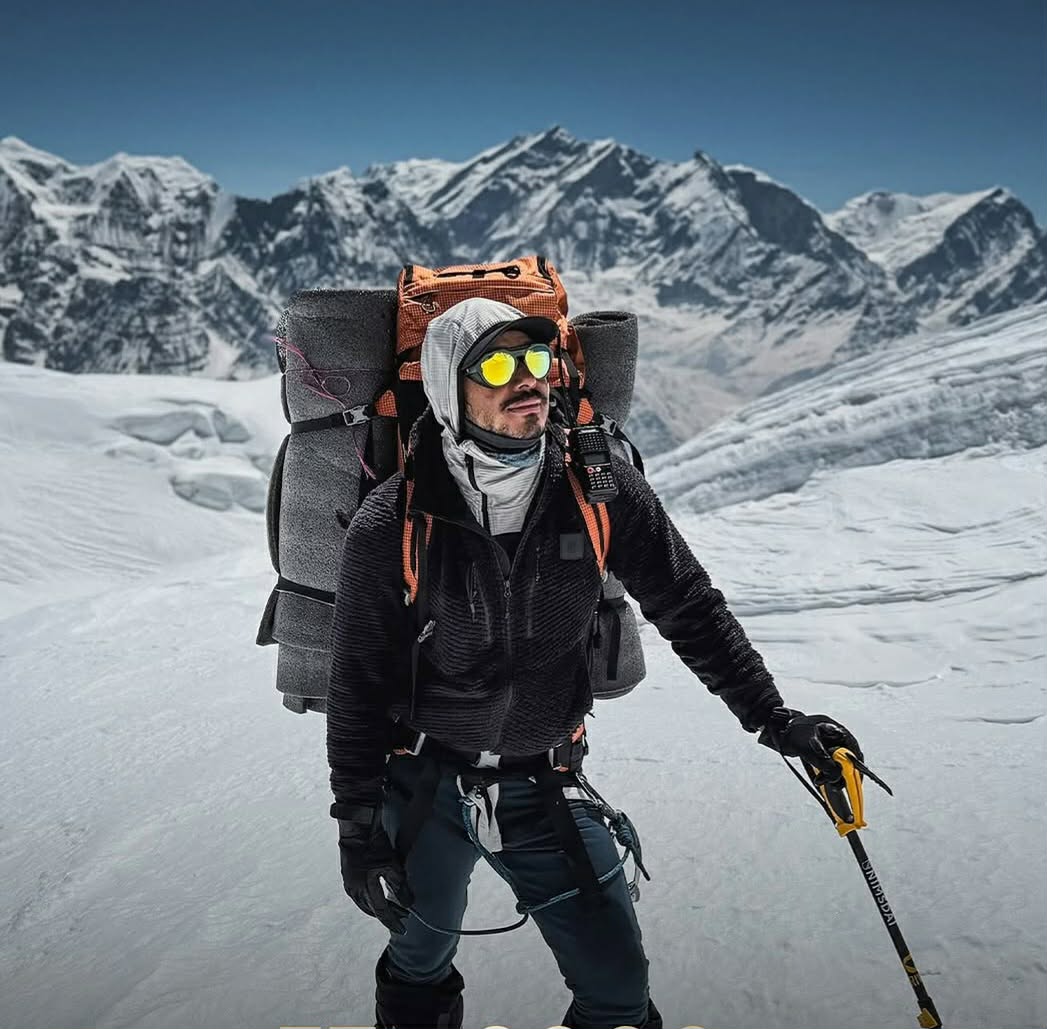
Nirmal “Nims” Purja, 43, led the Elite Exped team. Nepal-born, British citizen, MBE, sixteen years in the British military between the Brigade of Gurkhas and the Special Boat Service. He’s the reason this story is leading news sites that have never run a mountaineering headline in their life. In 2019 he climbed all fourteen 8,000-metre peaks in 189 days, a record that had been measured in years before he broke it, and Netflix made a documentary out of it, “14 Peaks: Nothing Is Impossible.” He completed the first winter ascent of K2 in 2021 with a team of nine other Nepali climbers. His speed record eventually got beaten in 2023, but that didn’t slow him down. By the time he landed in Pakistan this summer he had 57 8,000-metre summits behind him, 29 without bottled oxygen, and he was chasing a second full round of all fourteen without oxygen. He’d already climbed Broad Peak once, part of a run through all five of Pakistan’s giants (Nanga Parbat, both Gasherbrums, Broad Peak, K2) in 26 days back in 2023, no bottled air, a Guinness record. His tracker now shows him sitting still at 5,878 metres, battery running low.
Pur Bahadur Gurung, known to friends as Yukta, was one of Purja’s own guides at Elite Exped, an IFMGA-certified mountain guide from Gorkha. He’s one of the two confirmed dead. From what’s coming out about the team, there weren’t paying clients on this stretch with Purja. It was mostly working guides, and Gurung would almost certainly have been right at his shoulder for the push toward the summit.
Nima Sherpa was also part of the Elite Exped group, one of the Nepali climbers under Purja. Less has surfaced publicly about his individual record so far, which is its own quiet reminder of how these expeditions work. The Sherpas and guides who carry the weight of these trips rarely get profiled the way the Western or high-profile clients do, even when they’re every bit as accomplished.
Gyalu Sherpa, from Okhaldhunga, was climbing with Seven Summit Treks, the same outfit as Nadhira Al Harthy. Same story here: a working guide, part of the backbone of the expedition, not someone whose bio gets written up until something like this happens.
Nawang Thindu Sherpa, from Makalu, rounded out the Seven Summit Treks team alongside Gyalu and Al Harthy.
Kili Pemba Sherpa, from Rolwaling in Dolakha district, was with Imagine Nepal. He is, by any measure, one of the most accomplished climbers on the mountain that day. He finished all fourteen 8,000ers himself just weeks before this, topping out on Nanga Parbat on July 3rd alongside fellow guide Lakpa Chhiri Sherpa and Chinese climber Wang Zhong, the same Wang Zhong who was on Broad Peak with him when the avalanche hit. Kili’s climbed Everest fifteen times and K2 twice. He was part of the first winter ascent of K2 in January 2021, the same expedition Purja was on. He’s guided a Chinese double-leg amputee, Xia Boyu, to the top of Everest, and a Russian double-leg amputee, Rustam Nabiev, to the summit of Manaslu. In 2017 he was part of a five-Sherpa team that recovered the body of an Indian climber from just below the Everest summit. He is, in short, exactly the kind of guide whose experience is supposed to keep people alive up there.
Wang Zhong, the Chinese climber, was on his 11th 8,000-metre peak going into this season, with only Gasherbrum II, Broad Peak, and Shishapangma left to complete all fourteen. He first climbed with Imagine Nepal on Everest in 2021 and has done ten of his eleven peaks with that same team. His first 8,000er was Cho Oyu, climbed with a Tibetan team. Once he finishes his remaining three, he’d become the latest Chinese climber to join the fourteen-peak club, a list that’s been growing steadily as more climbers from China take on high-altitude mountaineering.
Sohail Sakhi, the Pakistani guide, is from Hunza and led the fourth team, guiding American client Mallory Geis for a company called Moving Mountains, which he runs himself. His background doesn’t fit the usual mold. He studied pure mathematics at Quaid-e-Azam University in Islamabad before deciding, in his words, that the pull between the mountains and pure math was that “everything is abstract.” He never went back. He’s summited K2, Nanga Parbat, both Gasherbrums, Manaslu, and made an alpine-style attempt on Batura I. This season he’d already summited Kanchenjunga in Nepal, part of the rope-fixing team that prepared the route for other climbers, and he was one of only two climbers all season to summit both Nanga Parbat and K2 without bottled oxygen. Broad Peak was supposed to be his last big peak of the year. He’s also a working photographer, and he’s been vocal about how little credit Pakistani climbers and guides get compared to the Nepali and Western outfits that have grown fast in the Karakoram over the past several years, a frustration he’s talked about openly in interviews before any of this happened.
Mallory Geis, 39, was Sakhi’s client, from San Antonio, Texas. This was her first attempt at an 8,000-metre peak. She’d previously summited Lobuche East and Mera Peak in Nepal, both well under 8,000 metres, and earlier this year she closed her Pilates studio to, in her own words on social media, take a leap of faith into the unknown, adding that she suspected there’d be a lot of helmets, harnesses, and crampons involved. She’d written online about how at peace she felt in northern Pakistan, calling it ironic given the narratives people in the West get fed about that part of the world. Her tracker showed a fall of roughly 543 metres when the slope let go.
Nadhira Al Harthy, the Omani climber, was with Seven Summit Treks and is the other confirmed dead. In 2019 she became the first Omani woman to summit Everest. She went on to climb K2, Manaslu, and Nanga Parbat, and was working toward all fourteen 8,000ers herself. Her tracker recorded the steepest fall of anyone on the mountain that day, more than 1,600 metres, nearly to the base.
Ten climbers. Four teams. Decades of combined high-altitude experience between them. None of it stopped the mountain.
Four bodies, two names
By Friday morning, ground teams had reached the debris. Some of the climbers swept up in the slide were carried down through an overland effort after bad weather kept the helicopters grounded early on, and the four bodies came out during that same push.
Two names are confirmed. Nadhira Al Harthy and Pur Bahadur Gurung. The other two haven’t been named yet, and I won’t guess. Guessing is how families find out from a rumor instead of an official.
Alpine Club president Irfan Arshad Khan has been the one fielding questions from reporters, and he’s kept saying the same thing: identification is still ongoing. Alpine Club vice president Karrar Haidri has also been speaking to reporters, and said the team had been out of communication since Thursday, that army helicopters had joined the search, and that authorities were in contact with every family involved. He said, plainly, that everyone was praying for a safe return.
Six still missing, and an actual update
That leaves six missing, Purja among them. And there’s a real update here, the first concrete one since the slide.
Purja’s business partner, Mingma David, says the latest satellite ping puts him at 5,878 metres with a movement speed of zero. That doesn’t mean he’s conscious, or even alive. It just means the device is sitting still instead of continuing to fall or shift through snow. Which matters, because up until now nobody could say whether earlier movement on the tracker was Purja himself or just the debris settling around it. The battery’s reading low, so there’s a real chance this signal is one of the last they get. He hasn’t been found. He also hasn’t been confirmed dead. Anyone telling you different right now is making it up.
Karakoram Expeditions had two of its own people caught in the same slide, team member Waqar Ali and Sona Sherpa reportedly among them, alongside two local climbers, also silent. One small bit of good news in an otherwise miserable stretch: the team monitoring one of those climbers’ satellite communicators picked up a slight movement signal overnight.
Weather turned clear Friday morning and is supposed to hold through the weekend, which is about the best break a rescue at this altitude gets. Alpine Club general secretary Ayaz Ahmed Shigri says four of the missing are showing up on GPS. Two Pakistan Army Aviation helicopters lifted off around 8am local time, loaded with rescue personnel, oxygen, and specialised equipment. Well-known local climbers Sirbaz Khan and Sherzad Karim joined the aerial search. Having people who actually know this terrain in the air counts for something. They notice things a standard crew might miss: a shift in snow texture, a flash of color against white.
Ground teams are still combing the debris field, looking for anything, or anyone. Thaneshwar Guragain of Seven Summit Treks, whose team has people among the missing, hasn’t sugarcoated it. The odds shrink with every hour.
Why Broad Peak at all
Here’s the part that stings most, honestly. Purja wasn’t even supposed to be up there.
He’d come to Pakistan chasing Gasherbrum II, and he closed that out in late July, his 57th 8,000-metre summit, done without bottled oxygen. Somewhere in the days after, he ran the numbers on his own career and realized one more trip up Broad Peak would leave just Cho Oyu standing between him and a second full round of all fourteen 8,000ers, again without oxygen. He’d stood on Broad Peak before. Familiarity with a mountain doesn’t count for much once a slope that size decides to move.
Before setting off he’d posted something on X, and it reads differently now than it did a week ago. He wrote that he was only asking Broad Peak for a safe trip up and back, that he never took a mountain for granted, that he was giving it everything from the moment he left base camp, same as always. Climbers say things like that before a big push all the time. Nobody expects it to be the last thing people quote back at them.
Who Nims Purja is, for anyone just hearing the name?
For anyone who doesn’t follow this world closely, here’s why a mountaineering accident in a range most people couldn’t point to on a map is leading the news.
His first real brush with the mountains was a trek to Everest Base Camp in 2012, and something about it never let go of him. That turned into Project Possible, the 2019 expedition that made him famous. He kept climbing after that, kept setting records most people assumed weren’t possible anymore. He also started the Nimsdai Foundation, which funds schools and community projects in Nepal, including a shelter for high-altitude porters that opened earlier this year. He’s talked a lot, publicly, about wanting to open doors for Nepali guides, the people who make Western summit attempts possible and rarely get their names printed anywhere. Pur Bahadur Gurung was exactly that kind of climber. One of Purja’s own.
A mountain that’s taken people before
Broad Peak doesn’t have the reputation K2 does. It’s not considered as technical, nothing like the Bottleneck, nothing like Annapurna’s exposure. But altitude doesn’t care how a mountain grades on a difficulty chart. In 2013, three Iranian climbers died descending after a summit. In 2018, an Icelandic climber was killed in an avalanche near Camp 2, not far below where this week’s slide hit. In 2021, a Russian-American climber ignored his partner’s warning and pushed on alone into bad weather and didn’t make it back. In 2022, a Pakistani climber fell through a weak cornice near the summit ridge, and separately a Scottish climber vanished near the top and was later presumed dead. Pakistan’s worst mountaineering disaster in modern memory happened one mountain over, on K2 in 2008, when eleven people died in a single accident. K2 and Broad Peak share weather, share base camps close enough to see each other across the valley, and share a long record of taking climbers who knew exactly what they were doing and still didn’t come home.
None of that makes this week easier. If anything, it makes it worse. These are people who’ve spent years learning to read snow and weather windows, and they still ended up under a slope that gave way without warning. Skill buys better odds. It doesn’t buy certainty. It never has.
What rescue at this altitude actually looks like?
For anyone who hasn’t spent time around expeditions like this, it’s worth explaining why a rescue up here drags on so much longer than people expect. At 6,600 metres, helicopters are working near the limit of what their engines can do. Thin air means less lift, less lift means less weight they can carry, which means fewer people and less gear per flight. The pilots flying these missions in Pakistan are some of the best in the world for exactly that reason. The margin for error is razor thin. A gust of wind or a drop in visibility, and a mission that was possible an hour earlier is suddenly off the table.
Ground teams have their own version of the same problem. Moving through avalanche debris at altitude means slower progress, faster exhaustion, and a real risk that a slope which has already slid once could go again. The four bodies pulled out so far came from a small team working directly inside that debris field, at genuine personal risk, because that’s what it costs to bring people home.
Clear skies through the weekend is the single biggest gift this search could get. It’s the difference between helicopters flying and helicopters sitting on the ground.
Where it stands
So that’s where it stands. Four dead, two named. Six missing, Purja among them, his tracker now showing a fixed point and a battery running out instead of nothing at all. Helicopters in the air. Ground teams still working the debris. Weather holding, for the moment.
Nobody in the climbing world is calling this finished, and they shouldn’t. There’s still a chance, thin as it is, that some of the six are alive and waiting to be found. That’s what the search is built around right now, and it’s what everyone watching this from a distance is hoping for too.
Purja has spent his whole career doing things that looked impossible until he did them. Fourteen 8,000ers in six months looked impossible. Five Pakistani giants in 26 days without oxygen looked impossible. None of that promises anything about what’s happening on that mountain right now. Mountains don’t care about a résumé. But it’s part of why so many people, climbers and non-climbers alike, aren’t ready to stop hoping yet.
For Nadhira Al Harthy’s family and Pur Bahadur Gurung’s, the waiting is already over, and it ended the worst way it can. For six other families, it continues, and every hour of clear sky over Broad Peak is another hour the search teams get to keep looking.
This is still moving. I’ll keep watching it, and so will a lot of people who’ve never met Nims Purja but have spent the last day and a half hoping the mountain gives him back.
Note: This is a developing story. Names, numbers, and the status of individual climbers may change as rescue teams reach the site and more official information comes in.
